Category: Insights

  • The Sunken Cost Trap: Why Sticking with Legacy Tech is Costing You More Than Switching

    The Sunken Cost Trap: Why Sticking with Legacy Tech is Costing You More Than Switching

    Every day, someone on your team faces the same, silent struggle. Imagine Sarah in customer service: she spends her morning wrestling with sluggish software, waiting minutes for simple reports to load, copying data by hand between mismatched systems. It’s not just an inconvenience—it’s a daily drain on her energy and focus. Technology should work so seamlessly that you don’t notice it, but when it becomes outdated, your team’s productivity gasps for air. Yet, many growing businesses are quietly suffocating their teams by forcing them to use legacy systems that simply can’t keep up.

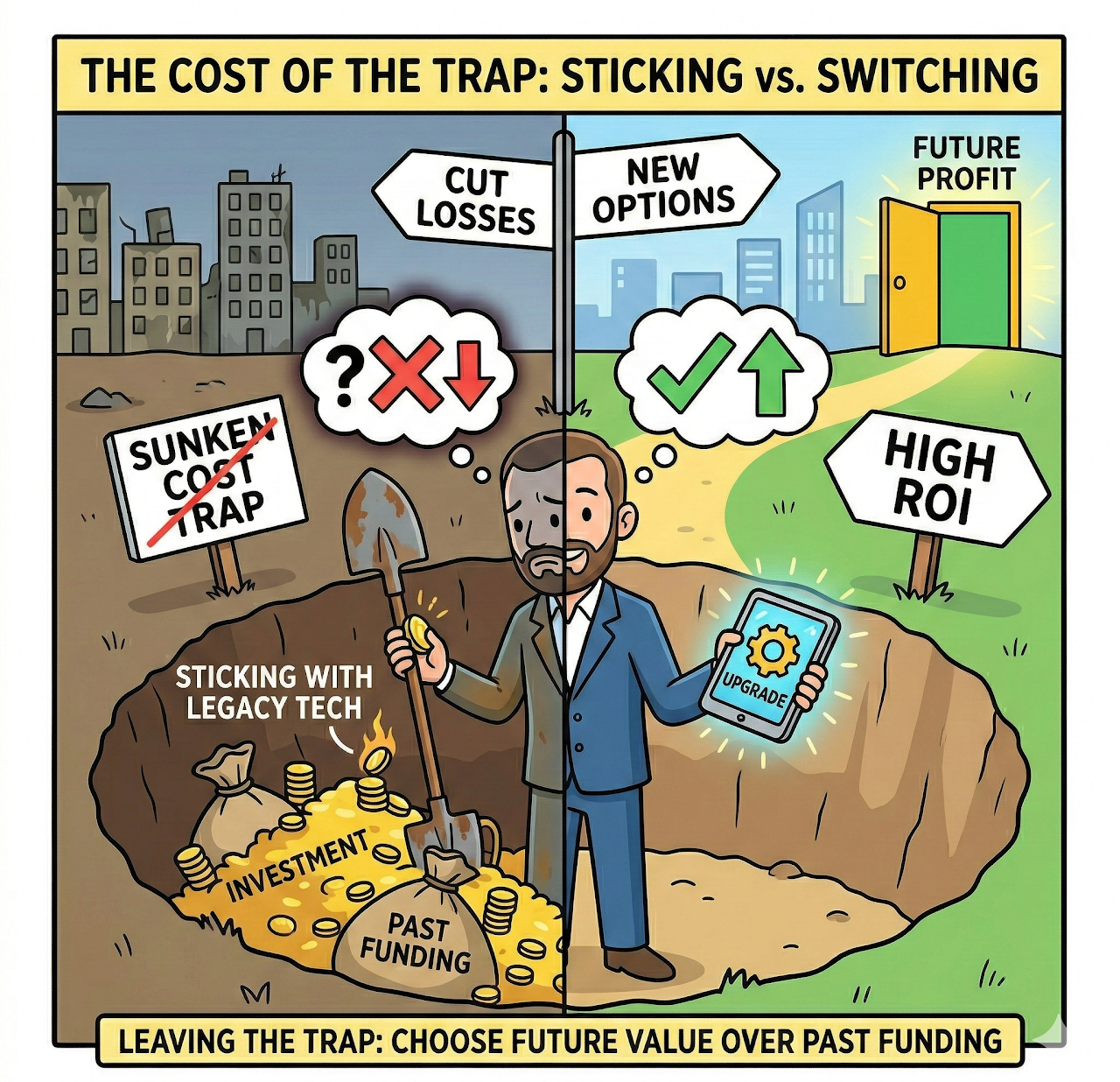
    Why does this happen? A single, jarring statistic makes the underlying bias clear: the average employee can waste hours each week struggling with outdated technology, and companies with legacy systems experience higher turnover among frustrated staff. Yet, most decision-makers are caught in the sunk cost trap. They feel that because the initial financial and operational investment in the old software was overwhelming, they must keep using it until they reach payback. They try to avoid the pain of switching costs, but in doing so, they create a much bigger problem.

    The Hidden Cost: Challenging Your Staff

    What leaders often miss is that the true cost of this complacency isn’t just financial—it is deeply human. When you cling to legacy tech out of obligation, you actively challenge your staff by forcing them to work with inadequate systems. Most employees become disengaged when forced to use outdated or ineffective technology, which negatively affects workplace morale and overall company culture. When frustration festers, a delay in updating technology directly threatens not only productivity but also the shared sense of purpose and trust within your team. Creating urgency for change begins with recognizing this risk and quantifying its impact.

    When software doesn’t fit the workflow, employees are forced to create manual workarounds, such as relying on disjointed spreadsheets or double-entering data. Consider this: Sarah spends an extra 20 minutes each morning manually reconciling sales reports between mismatched tools. One day, a simple copy-and-paste error goes unnoticed, leading to an inaccurate inventory count. This small mistake delays an important shipment, frustrating a key customer. That customer chooses a competitor for their next order, which means lost revenue for your business. What started as one manual workaround has now cost both employee morale and direct income. This chain reaction—from frustration to costly errors to customer churn—shows how clunky technology impacts productivity and profitability at every level.

    Happy Teams Lead to Happy Customers

    The core philosophy of a customer-centric business is simple: happy teams lead to happy customers. Your employees are among your company’s most important assets, and technology should simplify their work, not complicate it. When technology streamlines your employees’ daily work, you see results reflected in key customer metrics such as Net Promoter Score (NPS), customer satisfaction, and renewal rates. For revenue-minded executives, these are tangible indicators: companies that invest in employee experience often report improvements in NPS and increased customer retention, translating directly into revenue growth.

    If your team is exhausted from fighting their own tools, they simply do not have the bandwidth or the morale to provide a seamless, empathetic experience to your buyers. A customer-centric approach must start with a positive employee experience. Conversely, when you help your teams adopt new, efficient technology, you empower them to perform better. Freeing them from repetitive, manual tasks allows them to focus their energy on high-value interactions, which naturally results in better-served, happier customers.

    Picture this: Sarah, once bogged down by tedious data entry, now has hours returned to her each week. With that extra time, she launches a new customer follow-up initiative, quickly addressing concerns and suggesting upsell opportunities based on real-time insights from the improved platform. Within weeks, customer satisfaction scores tick upward, and new business begins flowing in from loyal clients who feel truly understood. By reclaiming time from outdated technology, your team can drive the kinds of innovative, value-adding efforts that set your business apart.

    Understanding and Overcoming Switching Costs

    Research shows that organizational resistance to performance-enhancing innovations often boils down to complacency inertia and the disincentive of switching costs. Leaders fear the indirect costs of switching, such as the time their team will spend learning the new software and the potential disruptions to daily workflows during the transition.

    Instead of viewing switching costs as a setback, it is more effective to frame them as a strategic investment. Just as businesses expect an initial outlay before realizing profit, adopting new technology also has a break-even point.

    Imagine a simple trajectory: while training and adjustment may require an upfront investment of hours or resources, the resulting efficiency gains and productivity improvements quickly outpace these early costs, often within just a few months. Visualizing this crossover point can help teams see the moment when benefits eclipse the initial investment, transforming hesitation into commitment.

    However, the price of not having a good system is that your team will never have enough time to innovate. To break free from the sunk cost trap, you must reframe how you look at software ROI:

    1. Conduct a Holistic Cost-Benefit Analysis: Don’t just look at the price tag of a new license. Weigh the intangible benefits—such as improved employee morale, enhanced data accuracy, and stronger customer loyalty—against the hidden, indirect costs of maintaining your frustrating legacy system.
    2. Use Information Flow to Break Resistance: Information flow is the key to breaking through the resistance barrier. During the rollout phase, clearly communicate the “why” to your team. Show them how the new technology will directly benefit them, reduce their manual labour, and make their daily tasks easier.
    3. Empower visible champions within your team by designating “super users” as internal advocates. These super users can serve as early adopters, share their success stories, and demonstrate real improvements, helping address peers’ concerns. Assign them the role of technology mentors, responsible for guiding colleagues through the transition and surfacing feedback to decision-makers. Naming these champions and sharing their stories in team meetings or updates helps accelerate adoption by building a visible coalition that inspires trust and enthusiasm for change.
    4. Deploy Agile Phased Rollouts: Minimize operational switching costs by testing changes with a small team first before rolling them out company-wide. This reduces disruption and builds internal confidence. It can also help create super users who will volunteer to help other teams adopt and use the new technology.

    The Bottom Line

    Don’t let the ghost of a past software investment ruin your future growth. By breaking out of the sunken cost trap and upgrading your digital ecosystem, you remove the friction that exhausts your staff. When you give your team the right tools, you equip them to deliver the exceptional service your customers deserve. Invest forward, don’t repair backward.

  • The 2026 Growth Playbook: Building a Resilient Business When Cash is Tight

    The 2026 Growth Playbook: Building a Resilient Business When Cash is Tight

    The industrialist Charles Schwab once said, “The best place to succeed is where you are with what you’ve got.”

    As we look toward the economic landscape of 2026, those words have never been more relevant. According to the Business Development Bank of Canada (BDC), the upcoming business environment will remain highly volatile. With the impending renegotiation of CUSMA, evolving tariffs, a weak Canadian dollar, and rising salaries, businesses are facing immense cost pressures.

    Profitability is now the central challenge for companies. When cash is tight, you cannot afford massive, disruptive overhauls or bloated software budgets. Instead, you must focus on strategic growth by doing more with what you already have. The BDC recommends finding these growth opportunities through a “Build, Partner, or Buy” approach.

    Regardless of which path you choose, a streamlined, customer-centric digital ecosystem is the foundation you need to execute that strategy successfully. Here is your playbook for turning economic uncertainty into a competitive edge.

    The “Build” Strategy: Optimizing Your Existing Business

    If you choose to grow organically, the BDC suggests optimizing your business through “Market Penetration” (selling more to existing customers) and “Market Development” (finding new customer segments). To do either effectively, you must eliminate data silos.

    You cannot cross-sell or upsell to existing clients if your sales and support teams are trapped using disconnected systems. This is where the Attract, Nurture, Transact framework becomes critical.

    • By optimizing the Nurture pillar with a centralized CRM like HubSpot, Salesforce or Pipedrive, you ensure that costly leads never slip through the cracks, enabling your team to squeeze more revenue from your existing marketing efforts.
    • For Market Development, leveraging an agile CMS (like WordPress) empowers your internal team to quickly test new campaigns without relying on expensive external developers, keeping you fast and flexible.

    The “Partner” or “Buy” Strategy: Integrating for Growth

    The BDC notes that SMEs that buy a business earn four times the profits of those that grow organically. Partnering or acquiring allows businesses to rapidly enter new markets, gain new capabilities, and acquire talent.

    However, acquiring a competitor often results in a complex software stack, filled with duplicate platforms and underutilized SaaS subscriptions. If you are scaling through acquisition, it is crucial to immediately map the newly combined Customer Journey. By evaluating the combined technology stack, you can eliminate software duplication, integrate overlapping tools, and ensure the expanded company realizes the financial benefits of the merger without frustrating your newly combined staff.

    Fixing the Cost Crisis by Removing Friction

    With the BDC forecasting continued cost pressures from trade shifts and rising salaries, businesses must look internally to protect their margins. To offset these costs, you must identify and remove “friction”—the manual data entry, broken communication loops, and operational waste hiding in your current processes.

    You can systematically tackle this friction using the RICE technique:

    • Reach: How many customers will benefit from this fix?
    • Impact: How much will they benefit?
    • Confidence: How sure are we about these numbers?
    • Effort: How much work will it take to fix it?

    By filtering your technology opportunities through RICE, you ensure your team focuses strictly on high-impact, low-effort improvements. This eliminates wasteful spending and targets the exact inefficiencies that are draining your cash flow.

    Preparing for the Boom in Business Transitions

    The BDC reports that a massive wave of business transitions is coming: 1 in 5 entrepreneurs plan to close, transfer, or sell their business in the next five years.

    If you are one of the 20% planning to exit, remember that buyers invest in reliable systems, not just “founder’s intuition”. A buyer wants a business with a clean CRM, documented digital workflows, and high staff engagement with software. Achieving “Digital Maturity” ensures your business is a highly valuable and easily transferable asset, maximizing your return on the lifelong commitment of entrepreneurship.

    The Bottom Line

    While you cannot control macroeconomic factors such as tariffs or geopolitical tensions, you can control your internal operations. By adopting a customer-centric approach to your technology, you can successfully navigate this volatility and protect your profitability.

    Start where you are with what you’ve got. If your digital ecosystem is leaking cash or frustrating your teams, let’s start with a Customer Journey Map or a Software Engagement Check-Up to identify exactly where you can optimize for the road ahead.

  • Attract, Nurture, Transact: The 3 Pillars of a Growth-Focused MarTech Stack

    Attract, Nurture, Transact: The 3 Pillars of a Growth-Focused MarTech Stack

    Steve Jobs once said, “You’ve got to start with the customer experience and work backwards to the technology.”

    Picture a 20-person industrial distributor dedicated to serving its customers and growing the business. By exploring new technology, they open the door to innovative tools that streamline work and empower their team. With the right solutions, responses are faster, leads are easier to nurture, and customers enjoy a seamless experience.

    As your business grows, embracing technology can help your team deliver even greater value and make it easier for customers to choose you.

    To simplify your business and drive growth, we need to stop buying “tools” and start building a Digital Ecosystem.

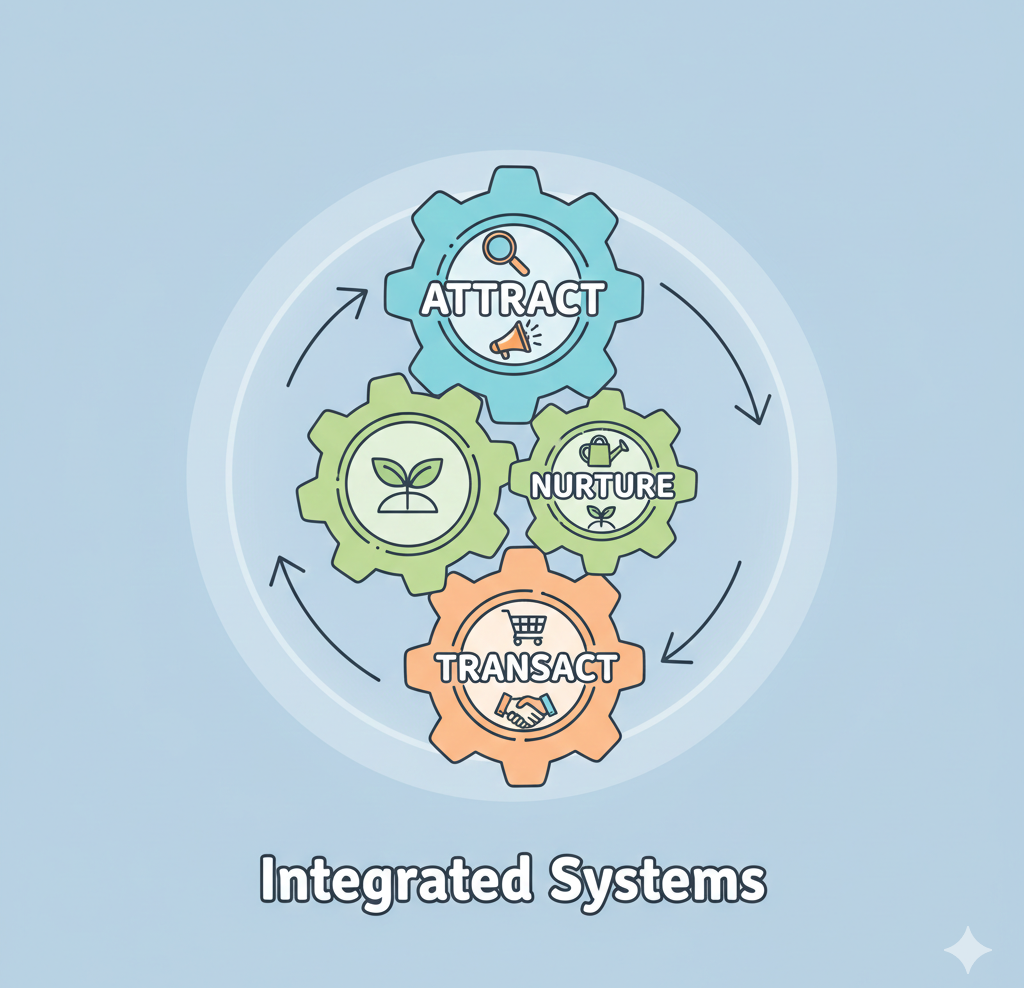
    It starts with a customer-centric mindset. Technology should help you win and serve customers. To do this, organize your tools into three pillars: Attract, Nurture, and Transact. Each pillar connects to a key metric—conversion rate, customer acquisition cost (CAC), and customer lifetime value (LTV)—so you can measure and improve results at every stage.

    It all starts with the foundation of a website you can manage without tech support.

    The Foundation: A CMS Your Team Can Manage

    Before we build the pillars, we need a solid foundation. For most businesses, that is your website.

    Too many growing companies are held back by their own websites. They rely on external agencies or developers to fix typos, upload photos, or change pricing. This bottleneck kills agility. You cannot react to the market if it takes two weeks to update a landing page.

    Your Content Management System (CMS)—whether it’s WordPress, Webflow, or HubSpot—must be user-friendly enough for your team to manage. When your marketing team can update content instantly without outsourcing, they become agile. This agility is the fuel for the three pillars of growth.

    Pillar 1: Attract (Engagement)

    The Customer Goal: “Help me find the solution I need.”

    Many businesses use marketing automation only for newsletters. In a growth-focused stack, this pillar is about engagement—attracting the right people by matching your strengths to their needs. Go beyond email: use social media retargeting to reach engaged audiences, and chatbots for instant, personalized interactions that keep leads interested.

    • The Strategy: Use data to find lookalike markets—people who share the same characteristics as your best existing customers.
    • The Tech: Platforms like Mailchimp or ActiveCampaign let you segment audiences by behaviour, not just demographics.
    • The CMS Connection: Your team uses your agile CMS to create specific landing pages for these segments. If you run an ad targeting plant engineers, your team can spin up a dedicated page speaking their language in hours, not weeks.

    Pillar 2: Nurture (Experience)

    The Customer Goal: “Understand me and help me make a decision.”

    This is where the gap usually forms. A lead arrives, but they aren’t ready to buy. If you ignore them, they leave. If you pester them, they ghost you. You need to nurture the relationship.

    • The Strategy: Consider Emily, a marketing manager at a mid-sized manufacturer. After downloading an eBook from your website, she receives a thank-you email with links to related articles. A week later, she’s invited to a webinar on the same topic. Following the event, she gets a personalized message from your sales team, offering insights and a one-month free trial. Through timely, relevant communication, Emily moves from curious lead to eager customer.
    • The Tech: A CRM like HubSpot, Pipedrive, or Salesforce gives everyone—Sales, Marketing, and Customer Service—a single view of each customer. This enables quick responses, prevents duplicate outreach, and reduces errors like mispriced quotes. With a unified CRM, your team works efficiently and delivers a smoother customer experience.
    • The CMS Connection: Your website forms must integrate directly with your CRM. When a prospect downloads a guide from your site, the CRM should automatically trigger a helpful email sequence—relevant to that specific guide—to nurture them toward a purchase.

    Pillar 3: Transact (Commerce)

    The Customer Goal: “Make it easy for me to buy.”

    The final pillar is Commerce. Whether you are B2B or B2C, the goal is to remove friction. If a customer has to jump through hoops to pay you or sign a contract, you risk losing them at the finish line.

    • The Strategy: Simplify the purchasing process. Allow shoppers to purchase where and when they want, and make the renewal process painless.
    • The Tech: For retailers, this is Shopify or WooCommerce. For service businesses, digital contracting tools like DocuSign or PandaDoc enable instant sign-offs.
    • The CMS Connection: Your CMS can be a powerful transaction engine, not just a brochure. Integrating commerce tools into your site lets customers move seamlessly from learning to buying, all within your brand experience.

    The Bottom Line

    When you view your technology through the Attract, Nurture, and Transact lens, your tools become powerful drivers of growth and opportunity.

    By grounding your marketing stack in a CMS your team controls, you empower them to move fast. You remove the friction that frustrates customers. You build a system where marketing, sales, and service work together to create happy, loyal customers.

  • The Atomic Approach to Digital Transformation: How 1% improvements can lead to 37x gains

    The Atomic Approach to Digital Transformation: How 1% improvements can lead to 37x gains

    We often talk about Digital Transformation as if it were a massive, singular event, a Big Bang that fundamentally changes a business overnight. It sounds exciting, but for most business owners, it feels expensive, disruptive, and overwhelming. However, delaying this transformation could be detrimental. Consider this: a 2019 Bain & Company study found that businesses that had not yet invested in digital transformation risked losing up to 30% of their market share to more digitally agile competitors. Imagine the financial impact of watching your revenue dwindle while competitors swiftly advance. By delaying, you might miss out on potential growth; you could also face significant losses.

    In his book Atomic Habits, James Clear introduces a concept that offers a better way forward: the rule of 1% improvements. He argues that if you get 1% better each day for one year, you’ll end up 37 times better by the time you’re done.

    When we apply this logic to business growth, the message is clear: You don’t need a revolution. You need Digital Maturity. Imagine a unicyclist who keeps balance through constant, small adjustments. Each subtle shift is vital to staying upright, not a single giant leap.

    Here is how you can use the “Atomic” approach to simplify your business and achieve exponential gains without the chaos of a total overhaul.

    1. Forget Goals, Focus on Systems

    Clear argues that winners and losers often share the same goals; the difference lies in their systems. Every business owner wants to grow from $1 million in revenue to $10 million. But the businesses that succeed are the ones that build the infrastructure to support that growth.

    When you grow past 10 or 20 employees, you can no longer rely on “founder’s intuition” or heroic efforts by individual staff members to solve problems. You need reliable systems.

    The “1% improvement” here isn’t buying the most expensive software suite. It is identifying one manual process and systemizing it.

    • The Project: Move your sales team from disjointed spreadsheets to a centralized Customer Relationship Management (CRM) platform like HubSpot, Salesforce, or Zoho. For instance, when adopting a CRM, a small firm can cut its lead response time by up to 50%. This simple change not only improves its ability to quickly engage new prospects but also boosts conversion rates by up to 20%.
    • The Gain: This single system upgrade eliminates manual data entry, prevents leads from falling through the cracks, and gives you a single view of your revenue pipeline.

    2. Make It Easy (Reduce Friction)

    A core law of habit formation is to reduce friction for good habits and increase it for bad ones. In business, friction is the hidden cost of wasted labour and frustrated customers.

    You cannot fix friction if you cannot see it. This is why I use Customer Journey Maps as a diagnostic tool. These maps reveal the hidden gaps between your departments—like when a customer has to repeat their story to Support because Sales didn’t share the data.

    • The Project: Integrate your website’s contact forms with your CRM.
    • The Gain: Instead of staff manually typing email leads into a database (high friction), the data flows automatically (zero friction). This small “atomic” change reduces errors and speeds up your response time, directly improving the customer experience.

    3. Use RICE to Pick Your 1%

    The challenge with the 1% rule is deciding which 1% to tackle today. Growing businesses are often flooded with ideas, leading to decision paralysis.

    To avoid the Big Bang trap, we reduce the scope by prioritizing opportunities using the RICE technique:

    • Reach: How many customers will benefit?
    • Impact: How much will they benefit?
    • Confidence: How sure are we about these numbers?
    • Effort: How much work will it take?

    By scoring your options, you can objectively identify the low-hanging fruit—projects with High Impact and Low Effort. This allows you to stack small wins that compound over time, rather than stalling out on a massive project that takes months to launch.

    4. Continuous Improvement is a Habit

    Finally, technology is only useful if your team actually uses it. A system is only as good as the habits of the people running it. To ensure effective adoption, leadership must take ownership of these new habits. By actively demonstrating the desired use of software daily, leaders can set a powerful example that encourages the entire team to follow suit. When leaders visibly incorporate these tools into their own routines, it helps shift cultural norms and accelerates acceptance throughout the organization. New software implementations often fail because staff revert to old ways, clinging to the “we’ve always done it this way” mentality. To ensure your 1% improvements stick, focus on Software Engagement.

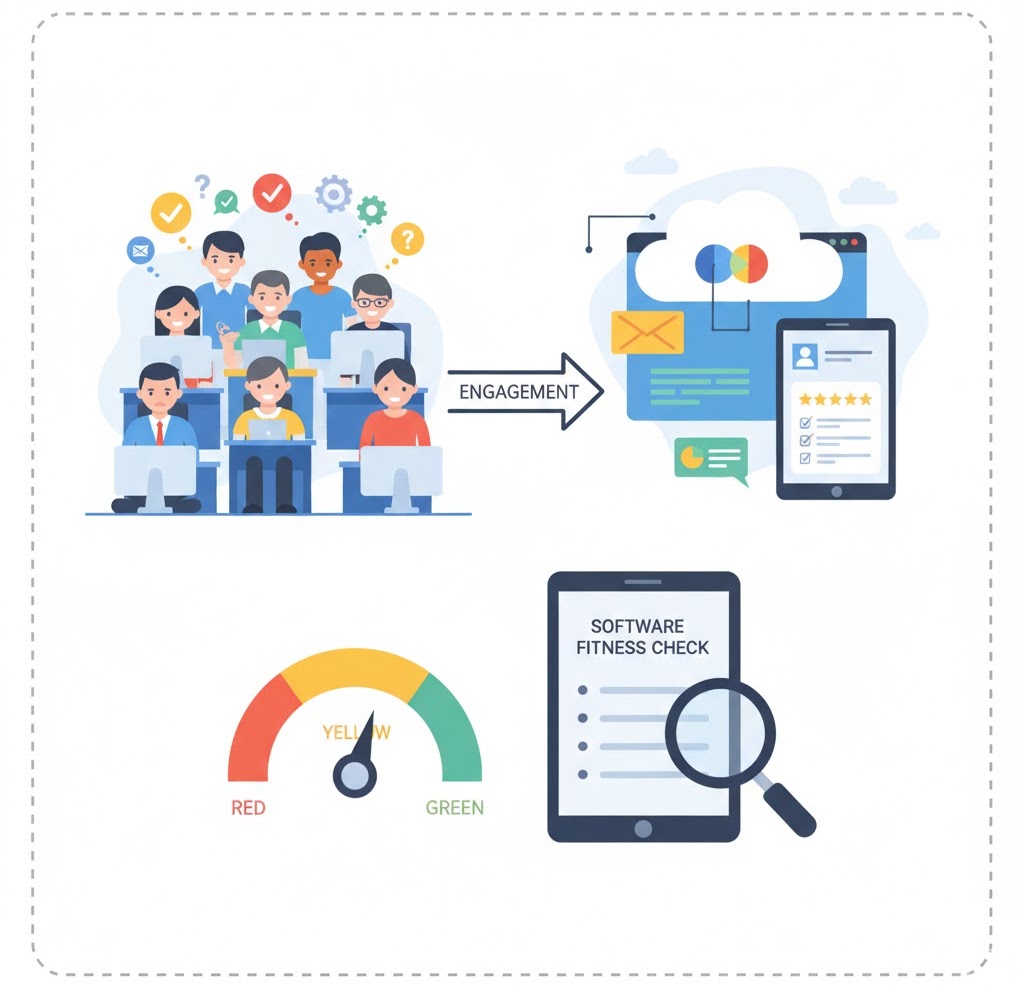
    • The Project: Conduct a simple Software Engagement Check-Up. Ask your team if the tools they use make them more productive or if they are using workarounds.
    • The Gain: If engagement is low, the solution might be targeted training or a simpler tool rather than a complex upgrade. To emphasize the value of simplicity, consider the costs: targeted training can be tailored to your team’s needs and typically costs a fraction of a full platform swap. A tailored training session might cost you a few thousand dollars, while a complete transition to a new system can run into tens of thousands, not to mention the downtime and potential productivity dips during the adjustment phase. This ensures your team adopts the new habit, securing your ROI.

    The Bottom Line

    Digital Transformation isn’t a destination; it is a habit. It is the commitment to being slightly better, faster, and more efficient today than you were yesterday.

    By breaking your growth down into prioritized, manageable projects, you turn uncertainty into profitability. Stop looking for the silver bullet. Start looking for the 1% improvement you can make today. What single, specific action will you commit to before the end of today to inch your business forward? Whether it’s optimizing a process, adopting a new tool, or refining a customer interaction, pledging to that one change can pivot insight into tangible results. Challenge yourself to make that commitment now.

  • The High Cost of “I Don’t Know”: Why Data Silos Kill Customer Service

    The High Cost of “I Don’t Know”: Why Data Silos Kill Customer Service

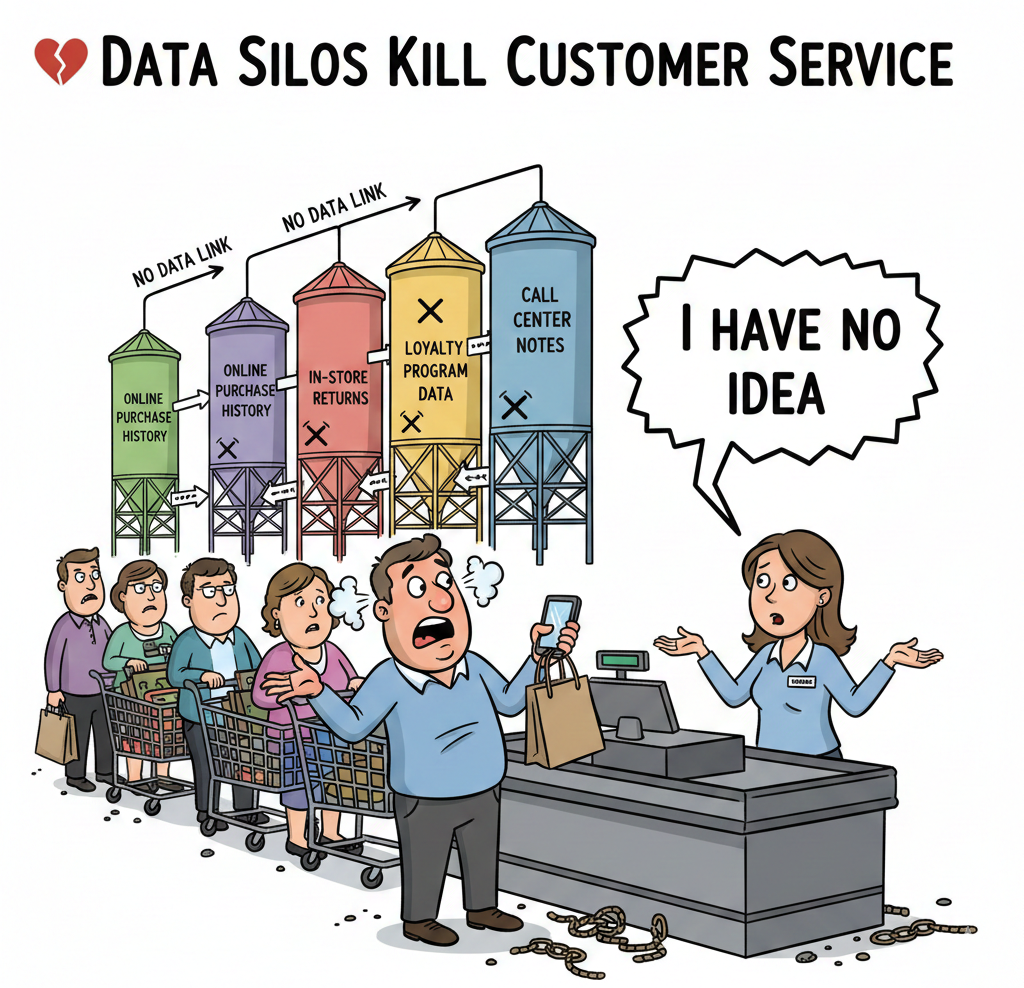
    Nothing frustrates a customer more than hearing a frontline employee openly admit, “I have no idea.”

    It is a scenario that plays out too often: A company promises impeccable service during the sales process, but when the delivery fails—arriving partially, poorly, or not at all—the burden shifts to the customer. Suddenly, you are no longer the client; you are the project manager. You are forced to hunt through the organization, explaining your story to different people, trying to find the one person who can deliver on the salesperson’s promise.

    This isn’t just a mistake; it is a significant service failure. It signals to your customer that your departments don’t communicate with each other. To fix this, we must look beyond the symptoms and address the root cause: data silos and communication breakdowns.

    The “I Don’t Know” Epidemic

    When a customer calls with a problem, they expect the person answering the phone to have the answer—or at least access to it.

    However, in many growing businesses, sales data lives in one system, while order fulfillment and support data live in others. This fragmentation creates a “myopic” view for your employees. Your support team can’t see what was promised because that data is locked in the sales team’s CRM. Your warehouse doesn’t know about the special instruction given to the account manager.

    The result? Your staff is forced to say, “I don’t know,” and your customer is forced to bridge the gap between your departments.

    Why Silos Form (and Why They Hurt)

    As companies grow from 10 to 50 employees, informal communication naturally breaks down. You can no longer rely on shouting across the office to update a colleague on an order. Without a structured digital ecosystem, departments begin to hoard data in their own specific tools—Sales uses a CRM, Operations uses an ERP, and Marketing uses an automation platform—and none of them are integrated.

    This creates Information Silos, which lead to:

    • The Broken Promise: Sales promises a specific delivery date or customization, but Operations never receives the memo.
    • Wasted Labour: Your team wastes hours manually transferring data or searching for files to answer simple questions, leading to errors and delays.
    • Eroded Trust: If a customer has to repeat their story to Sales, then Support, and then Management, they feel like a transaction number, not a person. This disconnect dilutes your brand consistency and damages loyalty.

    The Solution: A Single Source of Truth

    To ensure every staff member can address a customer’s needs, you must break down these walls. You need a “Single View of the Customer”.

    This doesn’t mean every employee needs to know everything, but they need access to the context of the relationship.

    1. Integrate Your Systems: Your CRM (Customer Relationship Management) should be the heartbeat of your operation. By integrating it with your Order Management System (OMS) and support ticketing platforms, data flows automatically. When a support agent opens a file, they should see exactly what the salesperson promised and the delivery status.
    2. Automate Internal Handoffs: Don’t rely on email to pass the baton. Use automation to trigger alerts for other departments when a deal closes or a delivery status changes. This ensures the next team is ready to execute without the customer having to chase them.
    3. Empower Your Team: When staff have access to accurate data, they stop saying “I don’t know” and start saying, “I see exactly what happened, and here is how I’m fixing it.” This empowers them to solve problems immediately, restoring the trust that was lost during the failed delivery.

    The Bottom Line

    Your customers shouldn’t have to work harder than you do to resolve a service error. If you promised X, your systems must ensure you deliver X.

    By removing data silos, you remove the friction that frustrates your customers. You transform your team from a group of disconnected departments into a unified force that delivers on your brand promise—every single time.

  • End Big Bang Change: Achieve Digital Maturity with Focused, Incremental Projects

    End Big Bang Change: Achieve Digital Maturity with Focused, Incremental Projects

    The Problem: ‘Digital Transformation’ feels overwhelming—impractical, disruptive, and costly for most businesses.

    The Reality: Businesses stall when they try to fix everything at once. Unused SaaS tools, poor integration, and manual work create roadblocks.

    The Solution: Rather than attempting sweeping, disruptive changes, organizations can instead build Digital Maturity—an approach focused on ongoing, practical improvements delivered through manageable projects. This mindset shift provides a clear, sustainable way forward.

    Digital Maturity vs. Digital Transformation

    Transformation is not a finish line but an ongoing process. Like a unicyclist adjusting, Digital Maturity needs constant, small improvements.

    With Digital Maturity, your technology evolves alongside your business. Teams become empowered to use tools effectively, reducing friction for both customers and staff. This shift gradually refocuses technology from a cost center to a key enabler.

    Step One: Diagnose Before You Prescribe

    Don’t start by buying software. First, find where your process hurts using a ‘Research and Assess’ phase, like Customer Journey Mapping.

    Businesses often have hidden gaps between departments. Mapping the journey highlights specific friction points. Rather than fixing everything, focus on the most painful gap first—then move forward incrementally.

    Step Two: Reduce Scope with Prioritization

    Once we see friction points, the solution list may still feel long. Resist the urge to do everything at once.

    Prioritize these opportunities using the RICE technique:

    • Reach: How many customers will benefit?
    • Impact: How much will they benefit?
    • Confidence: How sure are we about these numbers?
    • Effort: How much work will it take?

    By targeting high-impact, low-effort opportunities first, you’ll deliver results faster and build momentum for additional projects. Let’s look at what these smaller projects might entail.

    What a Small Project Looks Like

    To move from overwhelm to maturity, you need to focus on the path forward—identifying small, manageable projects with high impact, rather than being intimidated by the whole mountain. Here’s how that can look in practice.

    1. Move Sales from Spreadsheets to a CRM: Many businesses still track major revenue in spreadsheets. For example, a sales team that manually updates Excel sheets can migrate to a CRM. This centralizes data, enables teams to easily track opportunities, and gives everyone real-time pipeline visibility.
    2. Test eCommerce with WooCommerce: For physical retailers, digital doesn’t mean building an Amazon. For instance, a shop selling home goods can add WooCommerce to their existing site to test local online sales, learning which products succeed online before expanding further.
    3. Regain Control of Your Website (CMS): Relying on agencies for website updates slows marketing. If your marketing team must wait weeks for content changes, switching to a user-friendly CMS allows them to quickly update product info or promotions themselves, saving time and money.
    4. Integrate Your Contact Forms with Your CRM: If your website forms just send to email, you have a data gap. By connecting your CMS to your CRM, you automate data flow, reduce manual entry, and prevent lost leads. These are the sorts of manageable projects that build Digital Maturity through steady progress.

    Step Three: The Agile Approach

    Make each change a focused project, not an organization-wide mandate, using an agile process.

    • Test Small: Start with a small team before wider rollout.
    • Iterate: Measure improvements and adjust based on feedback.
    • Engage: Projects fail without adoption. Train and communicate so staff understand and embrace the change.

    The Bottom Line

    For 10 to 50 employees, focus is essential. Break the journey into prioritized, manageable projects for stability and profitable growth—no total overhauls.

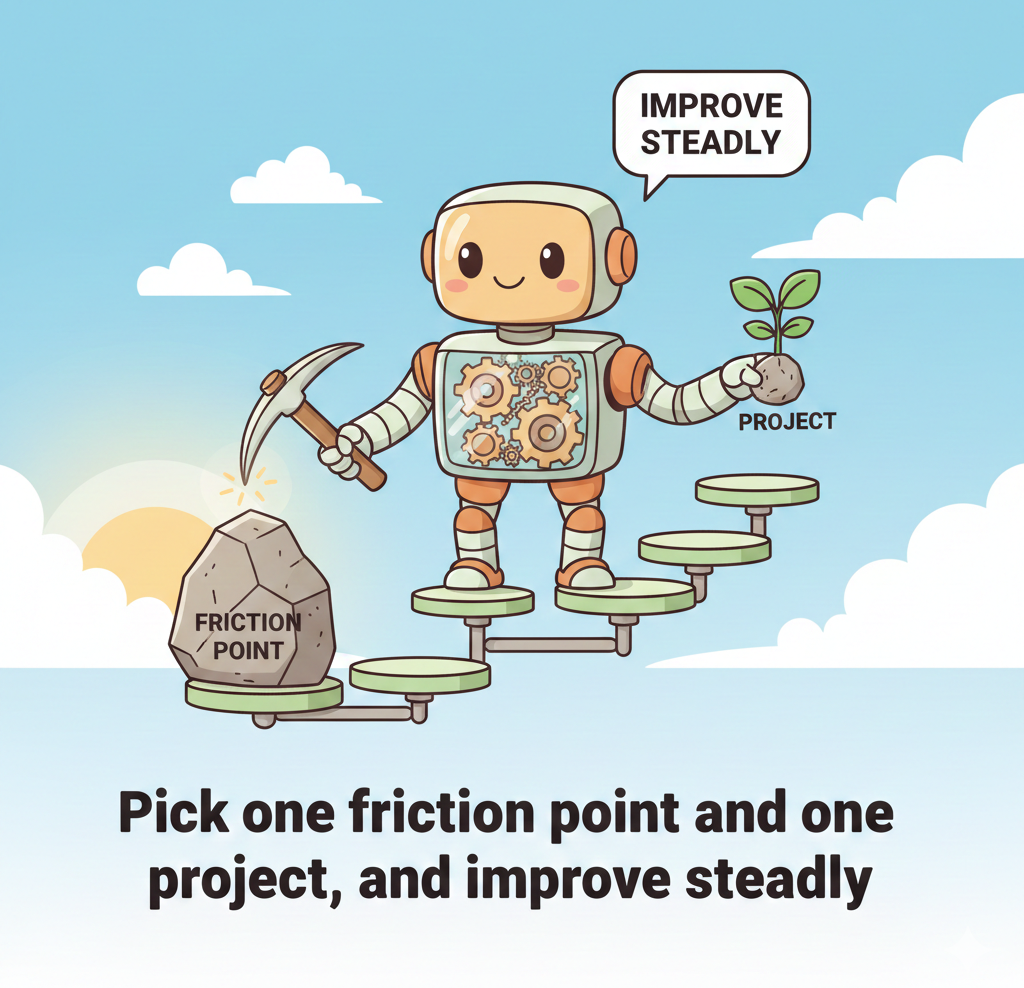
    Pick one friction point and one project, and improve steadily.

  • The 20-Employee Pivot: Using Technology to Empower Your First Middle Managers

    The 20-Employee Pivot: Using Technology to Empower Your First Middle Managers

    Growing a business is like a unicyclist maintaining balance—it requires constant motion. With fewer than ten employees, your structure was likely informal and personal. As you pivot past 20 employees, operations become more complex.

    At this stage, you can’t attend every meeting or oversee every transaction. Introducing middle management to lead specialized departments often creates “growing pains.” If not managed carefully, growth can dilute the branding and value that initially led to your success.

    To navigate this tricky phase, bridge the gap between your close-knit past and your new needs. Use technology to help your new managers. This will maintain company culture and service quality.

    The Visibility Gap: From Informal to Structured

    When your team is small, communication happens naturally. But as you grow, information silos begin to form. Your new managers need more than just “gut feelings” to lead; they need data.

    A Customer Relationship Management (CRM) platform provides your managers with a unified view of customer interactions, streamlining updates and highlighting issues before they affect the customer experience.

    Replacing the Founder’s Intuition with Process

    One of the hardest parts of delegating is trusting that your team will handle responsibilities with the same care you do. With 20+ employees, you must replace informal chats with structured processes.

    • Communication Tools: Platforms like Slack or Microsoft Teams prevent communication breakdowns by organizing conversations by department or project.
    • HR and Onboarding: When managers handle hiring, tools like Gusto, BambooHR, or Rippling help. They make onboarding consistent and help keep your company’s values strong from day one.
    • Marketing Automation: Tools like Mailchimp, Constant Contact, or ActiveCampaign allow managers to nurture leads and maintain a unified brand voice across all channels, even when you aren’t personally hitting “send”.

    Empowering Managers through Digital Adoption

    Technology is only useful when your team actually uses it. Often, businesses buy expensive software, but staff use workarounds, such as spreadsheets. This low usage hides costs and slows growth.

    Empower managers by conducting Software Engagement Check-Ups to ensure effective tool use. This helps identify training needs, boost productivity and morale, and streamline processes.

    Prioritizing Growth with the RICE Technique

    Your first managers may be overwhelmed by the number of improvement ideas. I help leadership teams use the RICE technique (Reach, Impact, Confidence, and Effort) to objectively prioritize which opportunities to pursue first.

    • Reach: How many customers will benefit?
    • Impact: How much will they benefit?
    • Confidence: How sure are we about these numbers?
    • Effort: How much work will it take?

    This systematic approach ensures your managers are focusing on the most cost-effective improvements that drive customer retention and profitability.

    The Bottom Line

    Turning into a managed organization should not feel like losing control. Instead, it should feel like building a strong base for more growth. By using the right technology, you make it easy for managers to give great service. This lets you focus on the bigger picture.

    If your digital ecosystem feels fragmented as you scale, let’s talk. Schedule a call to learn how technology can simplify growth for you and your management team.

  • From Uncertainty to Profitability

    From Uncertainty to Profitability

    The BDC State of Entrepreneurship Report delivered a clear message to Canadian businesses: uncertainty, geopolitics, and escalating costs are reshaping the future. Profitability is now the central challenge, with 40% of entrepreneurs prioritizing it over growth projects. The path forward demands strategic action: aggressive productivity increases driven by technology, process optimization, and a renewed focus on customer retention.

    I built my digital transformation consulting services to address these challenges, translating the BDC’s recommendations into a customer-centric path toward financial stability and competitive advantage.

    Profitability: Fixing the Cost Crisis

    The report confirms that rising costs are the main challenge, with over 40% of businesses dissatisfied with their current profitability. Many entrepreneurs seek internal solutions: 24% want to revise internal processes, and 25% are targeting cost reduction.

    When you simplify your business with technology, you make it easier to grow and create happier teams and customers. It’s one of the means I employ to drive profitability:

    • Focus on Friction: I designed my “Research and Assess” and “Develop the Plan” phases to map your customer journey and identify the areas of maximum friction—hidden costs and wasted labour. By reducing friction and streamlining software integration, you cut operational waste.
    • Systematic Optimization: My systematic approach (Research, Plan, Execute, and Share) helps businesses implement the “3 pillars of strong management” cited in the report: managing costs, tracking the sales pipeline, and ensuring internal alignment. Growth doesn’t always require adding new staff; you can increase your profits and improve revenue streams by fixing your underlying technical infrastructure and improving your cash conversion process.

    The Productivity Playbook: Leveraging Tech and AI

    The BDC report highlights that AI and technology are rewriting the productivity playbook, with 50% of businesses now using AI and 30% adopting new tech. However, technology only works when companies use it effectively. My services bridge the gap between investment and execution:

    • Strategic Adoption: I develop structured digital adoption plans to guide companies in selecting and scaling software (CRM, Analytics, CMS, eCommerce) to address specific pinch points as businesses grow from 10 to 50 employees.
    • Change Management is Key: The report notes that 22% of businesses focus on employee training to improve productivity. My “Share the Plan” phase addresses communication and employee training. Training ensures that staff use technology effectively, making your investment in productivity successful and proactive.

    Securing the Future: Retention and Business Value

    In an environment of increased competition and slowing demand, 28% of businesses are focusing on customer retention—that’s my core mantra: simplify your technology to focus on your customer. Simplifying your technology helps your teams help your customers. By mapping and refining your customer journey, I help you solidify your client base, making retention less expensive and more effective than acquisition.

    Customer-centricity leads to a healthier, more competitive organization. For the 1 in 6 entrepreneurs planning to sell, transfer, or close their business, a successful digital transformation ensures your company is a valuable, efficient asset, providing a strong return on the lifelong commitment of entrepreneurship.

    In essence, I translate the BDC report’s warnings into actionable, profitable, and customer-centric strategies, transforming uncertainty into a source of competitive strength.

  • Is Your Software Helping or Hurting? A Quick DIY Staff Engagement Check-Up

    Is Your Software Helping or Hurting? A Quick DIY Staff Engagement Check-Up

    As a business owner, you invest heavily in the software that powers your daily operations—from CRM and project management tools to industry-specific platforms. But here’s a critical question: Are your employees actually benefiting from and enjoying the software they use?

    It’s not enough for software to have the right features. If your staff is frustrated, confused, or actively avoiding their primary tools, that investment is silently draining your budget through lost productivity, workarounds, and increased staff turnover.

    Low software engagement is a hidden cost. Staff who dislike their primary tools will:

    • Spend valuable time finding manual workarounds.
    • Only using 20% of the features – missing out on the core value.
    • Avoid data entry – leading to unreliable business intelligence.

    The solution may not always be an expensive upgrade. Sometimes, the best course of action is to downgrade to a simpler, more affordable platform or to invest in targeted training. The first step, however, is determining the actual level of engagement.

    While a complete, professional Software Engagement Assessment provides a deep, expert analysis of your system and team, this simple, do-it-yourself questionnaire is a fast way to get a pulse on your organization.

    The DIY Software Engagement Questionnaire

    Ask your staff to complete this quick check-up anonymously for their primary, most critical piece of software (e.g., your CRM, ERP, or primary collaboration tool). It’s perfect for setting up quickly in an online tool like Google Forms.

    Ask your staff to rate the following six statements using a simple 5-point scale:

    1 = Strongly Disagree | 2 = Disagree | 3 = Neutral | 4 = Agree | 5 = Strongly Agree

    1. I feel more productive and efficient because of this software.
    2. I rarely need to use workarounds (like spreadsheets, emails, or notes) to complete my tasks in this software.
    3. If given the choice, I would recommend this software to a new colleague or another business.
    4. I look forward to using this software at the start of my workday.
    5. I have a clear understanding of all the key features I need to do my job effectively.
    6. If we remove this software tomorrow, my job would become significantly harder and take longer.

    How to Interpret the Results

    Once you collect the anonymous responses, calculate the average score across all employees and all questions. This average is your basic Staff Software Engagement Score (SSES).

    • SSES 4.0 – 5.0 (Green Light): Excellent Engagement. Your software is a powerful asset. Focus your efforts on maintaining current training and exploring minor updates.
    • SSES 3.0 – 3.9 (Yellow Light): Caution. Your team is likely split. Look closely at the lowest-scoring questions. A low score on #5 suggests a training gap. A low score on #2 indicates the software doesn’t fit the actual workflow. It’s a prime time to intervene.
    • SSES 1.0 – 2.9 (Red Light): Poor Engagement. This software is slowing your team down and costing you money. The risk of staff dissatisfaction and costly errors is high. You must take immediate steps to determine if the issue is poor implementation, poor training, or a fundamental software mismatch.

    Next Steps

    The goal of this quick check is to move past the assumption that “newer is better” and determine what your staff truly needs to succeed.

    If your SSES score lands in the Yellow or Red zone, you have two primary options:

    1. Internal Review: Follow up with a questionnaire to seek qualitative feedback and examine department averages. Is the sales team hating the CRM while finance loves the invoicing? Pinpoint the bottleneck.
    2. Professional Assessment: For many businesses, the problem is complex. When software is mission-critical, a DIY check-up is just the start. I can help you complete an in-depth Software Engagement Assessment to provide the objective, data-driven answers you need to decide whether to train, simplify, upgrade, or replace your core systems, ensuring your tech investments truly serve your business goals.
  • 10 Digital Transformation Symptoms Your Business Can’t Afford to Ignore

    10 Digital Transformation Symptoms Your Business Can’t Afford to Ignore

    Is your business truly thriving in the digital age, or are you just getting by? Many growing firms grapple with hidden inefficiencies that hinder progress and stunt growth. A successful digital transformation isn’t just about adopting new tech; it’s about optimizing your entire digital ecosystem to work for you. Identifying the pain points is the crucial first step.

    Here are 10 symptoms that signal it’s time to re-evaluate your digital strategy and invest in a more customer-centric, streamlined approach.

    1. Underutilized SaaS Subscriptions: Are you paying for software subscriptions that your teams barely use? A common symptom of a fragmented digital ecosystem is an accumulation of various SaaS tools, many of which you only use for a fraction of their capabilities. Regularly auditing your subscriptions can reveal significant savings and opportunities to consolidate your expenses.
    2. Software and Platform Duplication: This is a twin of the previous symptom. It’s easy for different departments to adopt similar platforms that perform overlapping functions. For example, your marketing team might use one CRM, while sales uses another, leading to redundant data and wasted spending. Consolidating these tools can create a more unified workflow and a single source of truth for your customer data.
    3. The “We’ve Always Done It This Way” Mentality: This mindset is a red flag. If your teams are sticking with outdated manual processes or legacy systems simply out of habit, you’re missing out on the efficiency gains and competitive edge that modern solutions provide. Digital transformation encourages a culture of continuous improvement and adaptation.
    4. Low Employee Morale and High Frustration: Listen to your teams. Are they constantly complaining about clunky software, slow systems, or frustrating workflows? Frustration with technology can directly impact productivity and lead to employee churn. A customer-centric approach starts with a positive employee experience.
    5. Poor Data Integration: Your sales data shouldn’t live in a silo separate from your customer service data. When your systems fail to communicate with each other, you lose valuable insights, forcing your teams to transfer information manually, leading to errors and delays. Seamless data integration is the backbone of a unified digital experience.
    6. Inconsistent Customer Experience: A significant goal of digital transformation is to provide a consistent experience across all sales channels. If a customer has a different experience on your website than they do via your social media or with your sales representative, you will dilute your brand presence. A unified brand message and value proposition are key to building loyalty.
    7. Lack of Clear ROI from Technology Investments: You’ve invested in a new system, but can you prove it’s delivering value? If you can’t measure the return on investment (ROI) of your tech stack, it’s impossible to justify future spending or identify areas for improvement. Every system should contribute to your bottom line, whether through increased efficiency, higher sales, or improved customer retention.
    8. Repetitive and Manual Tasks: Is your team spending hours on tasks that you should automate, such as data entry, report generation, or scheduling? These are prime candidates for digital solutions. Automation frees up your team to focus on high-value tasks that require creativity and critical thinking, like strategy development and direct customer engagement.
    9. Stagnant or Declining Customer Loyalty: If customer retention rates are flat or dropping, it could be a sign that your digital touchpoints are not creating a positive, consistent experience. Customers today expect personalized, seamless interactions. A robust digital strategy is key to enhancing loyalty and increasing customer lifetime value.
    10. Your Systems Aren’t Scalable: Is your current technology stack capable of supporting your business as it grows? As your customer base expands, a system that worked for a smaller team might break down under increased volume. Implementing scalable solutions from the beginning ensures your technology can grow with you, rather than hold you back.

    Recognizing these symptoms is the first step toward a more efficient, customer-focused, and profitable business. If any of these points resonate, it may be time to reassess your digital ecosystem. I can help you select and implement the right software, provide the necessary training, and support the change management process to ensure a successful digital transformation.